Destiny Matrix for Career — Why the Right Job Still Feels Wrong

Most people looking at their Destiny Matrix for career guidance are asking the wrong question.
The question they ask is what job should I be doing? The question the chart actually answers is why does the job I have feel like it costs more than it should?
Those are not the same question, and the difference matters. Plenty of people are in genuinely good roles — well paid, respected, using real skills — and still end each week depleted in a way that has no obvious explanation. Plenty of others have changed careers twice and found the same underlying dissatisfaction waiting for them in the new one.
That is not a job problem. It is an alignment problem, and it shows up in three specific positions of your Destiny Matrix chart.
This guide covers which three positions govern working life, the four specific ways they can misalign, how to diagnose which one applies to you, and what each of the 22 arcana indicates about the working environment you actually function well in.
The three positions that govern working life
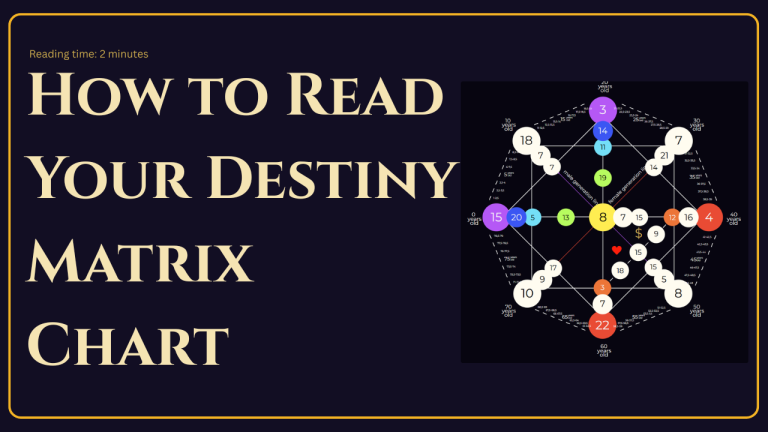
Your chart has 22 positions. Three of them relate directly to work, and they answer different questions.
Talent Zone — what you are naturally good at. The capacities that developed faster than average, usually so early that you never counted them as skills. Read the full Talent Zone guide for the individual numbers.
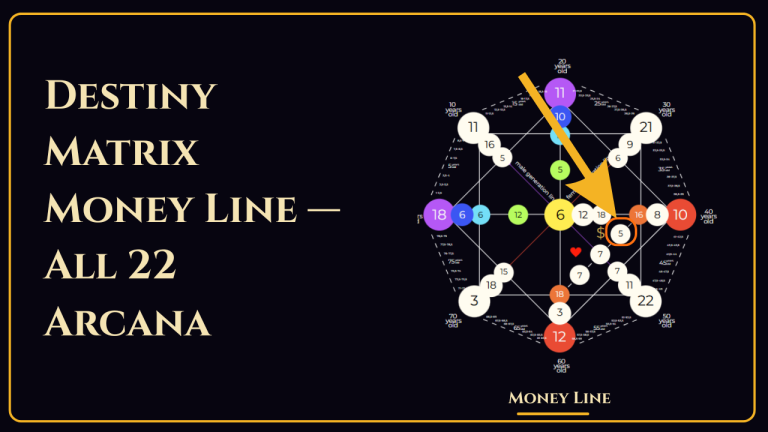
Money Line — how you are wired to earn. Not what you earn, but the structure of earning that suits you: employed or independent, salaried or variable, building or advising. The Money Line guide covers this in depth.
Purpose — what makes work feel like it counts. The direction that gives effort meaning rather than just returns.
Here is the part most career guides miss entirely: these three are frequently not pointing the same way. And the specific mismatch between them explains more about career dissatisfaction than any individual number does.
The four mismatch patterns
This is the diagnostic. Find yours, and the vague sense that something is off usually becomes specific.
Pattern 1 — Talent without Purpose
What it feels like: You are good at this. Objectively, genuinely good. People come to you for it. And it means nothing to you.
This is the most common mismatch among high performers, and the hardest to explain to other people. From outside it looks like ingratitude. From inside it feels like running a machine that produces results you do not care about.
How it shows up: Promotions that arrive as bad news. Competence that has become a trap — you are too good at this to leave it. A specific hollowness on Sunday evening that has nothing to do with workload.
What actually helps: Not a career change, usually. The talent is real and abandoning it wastes something. What tends to work is finding a context where the same capability serves something you do care about — the skill stays, the application changes.
Pattern 2 — Purpose without Talent
What it feels like: This matters to you. You believe in it. And you are working significantly harder than the people around you to produce comparable results.
This is the mismatch that produces burnout fastest, because the meaning keeps you in it long past the point where the effort has become unsustainable.
How it shows up: Working longer hours than peers for the same output. A quiet suspicion that you are not naturally suited to this, buried under the conviction that you should be. Frequent, exhausting comparison.
What actually helps: Finding the version of the mission that uses your actual Talent Zone. A cause usually needs more than one type of person — the mismatch is often between you and the role, not you and the purpose.
Pattern 3 — Talent and Purpose aligned, Money Line ignored
What it feels like: The work is right. The structure around it is not.
This is the mismatch nobody diagnoses, because the work itself is fine — which makes the persistent frustration feel irrational.
How it shows up: Right field, wrong arrangement. Someone wired for independence in a rigid corporate structure. Someone wired for stability grinding through freelance uncertainty. Someone who needs a team working entirely alone. The dissatisfaction attaches to conditions, not content.
What actually helps: Changing the structure, not the job. Same work, different arrangement — contract instead of employment, a smaller organisation, a partnership instead of solo. This is frequently the least disruptive fix available and the one people consider last.
Pattern 4 — All three aligned, and it still feels wrong
What it feels like: On paper, this should be working. It is not.
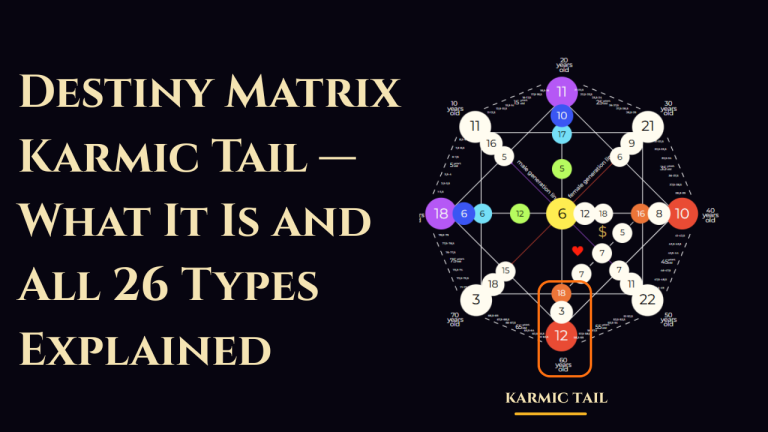
When all three career positions align and something is still off, the source is usually elsewhere in the chart — most often the Karmic Tail or the money block position.
How it shows up: Self-sabotage at the point of success. Undercharging in work you are demonstrably good at. Difficulty being visible. Leaving good situations for reasons that make sense at the time and not afterwards.
What actually helps: Looking outside the career positions. This is a pattern problem wearing a career costume, and no amount of career adjustment will resolve it.
How to diagnose your own
Take your three numbers and answer three questions honestly. Thirty seconds each.
Does my current work use my Talent Zone energy? Not “am I good at my job” — everyone gets good at their job eventually. The question is whether it uses the thing that came easily before anyone taught you.
Does my current work matter to me in the way my Purpose position describes? Not “is it useful work.” Whether it connects to the specific direction your chart points toward.
Does my current arrangement match my Money Line structure? Independent versus employed. Variable versus stable. Building versus advising. Not the industry — the shape of the deal.
Two yeses and one no gives you your mismatch pattern directly. Three yeses and persistent dissatisfaction points to Pattern 4.
The 22 arcana as working environments
What follows is deliberately not a list of job titles.
Job title lists are the standard approach and they are close to useless, for a simple reason: the same arcana produces a surgeon, a structural engineer, and a schools inspector. The common factor is not the profession. It is the conditions under which that energy produces good work.
So each entry below describes the environment, not the occupation.
1 — The Magician Works best with autonomy and a blank page. Needs the authority to start things without extended approval cycles. Struggles in environments where initiative requires permission. Environment signal: if you are waiting on sign-off more than three days a week, this energy is being wasted.
2 — The High Priestess Works best where judgement is valued over output volume. Advisory, analytical, or specialist positions. Struggles in environments measuring activity rather than accuracy. Environment signal: if nobody asks what you think, only what you finished, this is misaligned.
3 — The Empress Works best where something or someone grows as a result of the work. Teams, clients, products, places. Struggles in purely transactional roles. Environment signal: if you cannot name what got better because you were there, the energy has nowhere to go.
4 — The Emperor Works best with defined authority and long time horizons. Building systems, running operations, holding structure. Struggles in chaotic or constantly redirected environments. Environment signal: if the strategy changes quarterly, this energy spends itself on rework.
5 — The Hierophant Works best where expertise is transmitted — teaching, standards, professional practice. Struggles in environments that discard accumulated knowledge for novelty. Environment signal: if nothing you learned two years ago still applies, this energy is not compounding.
6 — The Lovers Works best through relationship. Partnership, client work, collaboration, anything where the connection is the medium. Struggles in isolated or purely technical roles. Environment signal: if your best work happens in meetings and your job is mostly not meetings, there is a mismatch.
7 — The Chariot Works best with clear targets and visible progress. Momentum-driven roles, sales, delivery, campaigns. Struggles in open-ended work without measurable movement. Environment signal: if you cannot tell whether this week went well, this energy stalls.
8 — Strength Works best in long-duration, high-pressure contexts requiring steadiness. Crisis roles, complex delivery, anything where others burn out. Struggles in environments demanding constant novelty. Environment signal: if the work is short-cycle and low-stakes, this capacity is idling.
9 — The Hermit Works best with deep focus and minimal interruption. Research, specialist practice, craft, independent work. Struggles in high-collaboration open-plan environments. Environment signal: if you get your real work done before 9am or after 6pm, the environment is fighting you.
10 — Wheel of Fortune Works best where timing and adaptation matter. Markets, cycles, changing conditions. Struggles in static, procedural environments. Environment signal: if nothing has changed in your role in three years, this energy has nothing to work with.
11 — Justice Works best where fairness and accuracy are the point. Legal, audit, standards, arbitration, quality. Struggles where results are expected regardless of how they are produced. Environment signal: if you are regularly asked to overlook something, this energy corrodes.
12 — The Hanged Man Works best with long lead times and permission to think before acting. Strategy, research, design. Struggles in reactive, deadline-dense environments. Environment signal: if every task is urgent, this energy never reaches the part where it is valuable.
13 — Death Works best in transition and restructuring. Turnarounds, endings, transformation work. Struggles in maintenance roles. Environment signal: if the job is to keep things exactly as they are, this energy will eventually break something.
14 — Temperance Works best mediating between parties or disciplines. Integration roles, partnerships, translation between functions. Struggles at either extreme of a spectrum. Environment signal: if you are being asked to pick a side permanently, this energy loses its function.
15 — The Devil Works best with material other people avoid — desire, appetite, difficult truths, the commercial realities others euphemise. Struggles in environments requiring constant diplomacy. Environment signal: if honesty is a political risk where you work, this energy is being suppressed.
16 — The Tower Works best where something needs to be dismantled honestly. Restructuring, whistleblowing contexts, disruption. Struggles in stability-preserving environments. Environment signal: if your main contribution is not rocking the boat, this energy has no outlet.
17 — The Star Works best in early-stage and vision-led work. Startups, creative direction, movement building. Struggles in mature, optimisation-focused environments. Environment signal: if the work is improving something by 3%, this energy will drift.
18 — The Moon Works best where the unstated matters — culture, mood, meaning, what people are not saying. Creative work, research into people, anything requiring reading beneath the surface. Struggles in purely literal environments. Environment signal: if only the explicit brief counts, this perceptiveness has no value here.
19 — The Sun Works best when visible. Public-facing, representative, teaching, leading from the front. Struggles in back-office invisibility. Environment signal: if nobody outside your team knows what you do, this energy is under-deployed.
20 — Judgement Works best where the work has consequence and requires honest assessment. Reviews, accountability, mission-driven organisations. Struggles where the work does not matter to anyone. Environment signal: if you cannot answer “who is affected by this,” this energy disengages.
21 — The World Works best on substantial, completable projects with defined ends. Large programmes, international work, things that finish. Struggles in perpetual maintenance. Environment signal: if nothing you work on ever completes, this energy loses its reward mechanism.
22 — The Fool Works best at the beginning of things. New ventures, unmapped territory, first-of-kind work. Struggles in mature operations. Environment signal: if the process already exists and works, this energy will not be the one to run it.
Reading the three together
Individual numbers are the least useful part of this. The pattern between them is where the actual information sits.
When Talent and Money Line share a character — the natural gift and the earning structure point the same way. Earning through the thing that comes easily is available to you, and it is not available to everyone. Worth taking seriously as a route.
When Talent and Money Line conflict — the classic version is a talent suited to independence with a money line suited to stability, or the reverse. The resolution is usually not choosing one. It is a hybrid structure: employed with an independent side project, or freelance with one anchor client.
When Purpose points somewhere neither Talent nor Money Line supports — this is worth sitting with rather than acting on quickly. It sometimes indicates a direction for later life rather than now. The Planetary Purpose position often clarifies this.
When all three share a number — unusual, and read as strong concentration. The direction is clear. The risk is that everything is loaded into one domain, which is fragile if that domain becomes unavailable.
What this cannot tell you
It cannot name your job. The same arcana appears in people doing entirely unrelated work. Anyone converting a birth date into a specific occupation is adding information the chart does not contain.
It cannot predict success or income. Salary is set by industry, geography, negotiation, timing and market conditions. A birth date has no access to any of it.
It should not override practical reality. If a job pays your rent and supports people who depend on you, a chart is not a reason to leave it. Alignment is one input among many, and it is not the most urgent one.
It cannot resolve burnout. Persistent exhaustion, dread, or inability to function is a medical matter before it is a chart matter. Speak to a doctor. A symbolic system is not equipped for that and pretending otherwise helps nobody.
What it can reasonably do
Give you specific language for a dissatisfaction you had already felt but could not describe. Distinguish between wrong job, wrong role, and wrong structure — three different problems with three completely different solutions, frequently confused for each other.
That distinction alone is worth the twenty minutes. Most career dissatisfaction gets diagnosed as “wrong job” by default, and the resulting career change often reproduces the same mismatch in a new industry.
Generate your free chart and locate your three career positions. Then read them against the four patterns above rather than looking up individual meanings — the pattern is where the answer usually is.
Frequently asked
Which of the three positions matters most for career? The Talent Zone if you are choosing a direction from scratch. The Money Line if the work is right and the arrangement is not. Purpose if the work is fine and you cannot make yourself care about it.
My chart points one way and I have already built a career elsewhere. Now what? Fifteen years of experience is a genuine asset and the chart does not outrank it. The more useful question is whether the alignment could be improved within your existing field — which is usually possible and considerably less costly than starting over.
The Destiny Matrix is a framework for self-reflection. Nothing here is career, financial or medical advice, and no career decision should rest on a chart reading. If work is affecting your health, please speak to a qualified professional