Destiny Matrix Relationship Channel — All 22 Arcana Meanings
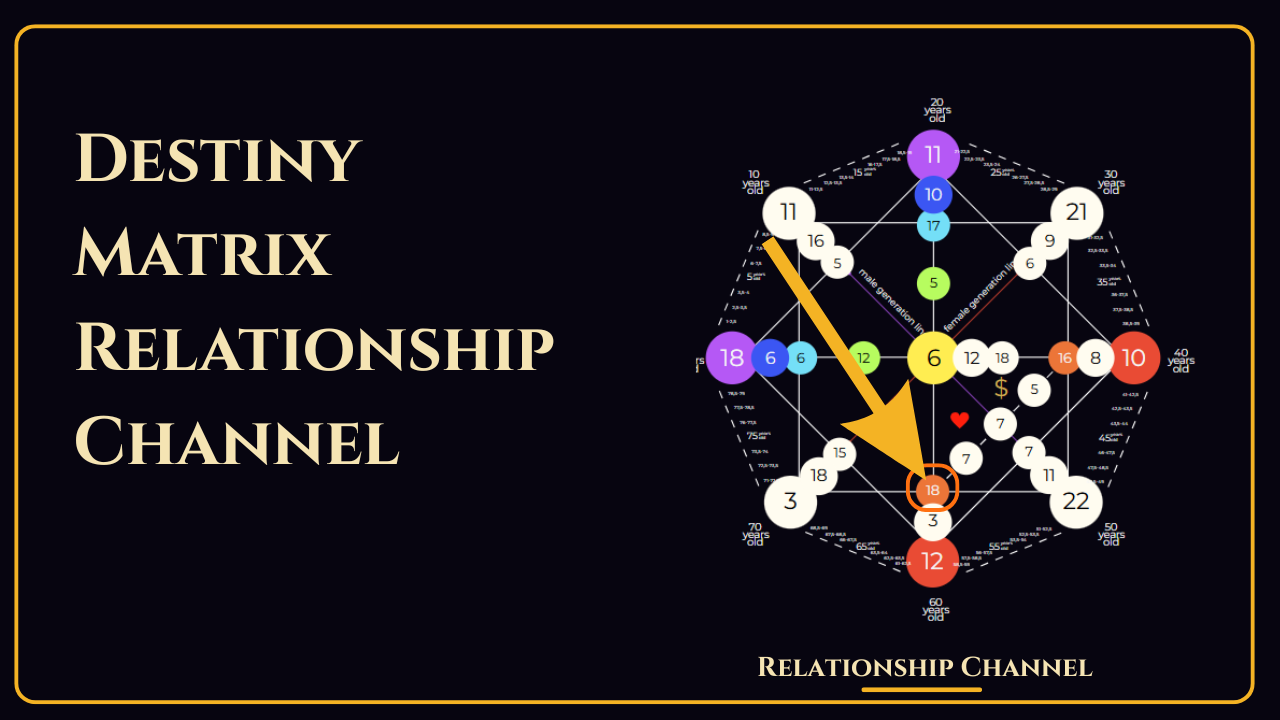
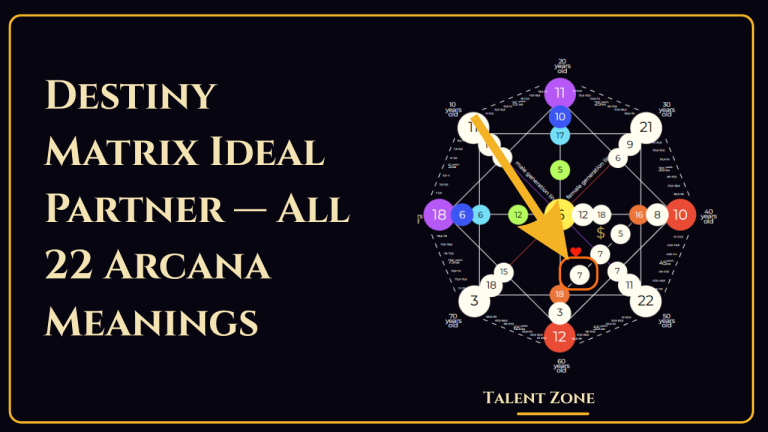
There is an orange circle in the karmic tail section of your Destiny Matrix chart. Most people walk straight past it when reading their chart for the first time — focused on the larger numbers, the karmic tail combinations, the love line. But this small orange circle carries some of the most specific and personally recognisable information in the entire chart.
It is called the Relationship Channel — or the Entrance to Relationships.
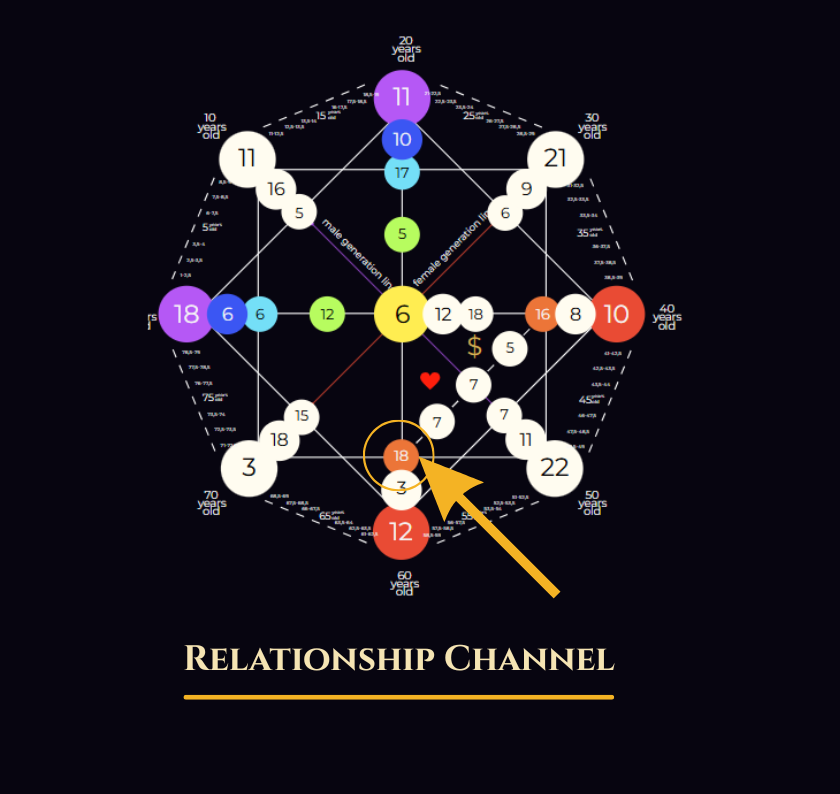
It sits in the karmic tail zone because it represents energy carried from a past life that is actively shaping how you enter, experience, and sometimes sabotage your closest relationships in this one. It is not about who you attract. It is about the specific pattern that activates the moment a relationship becomes real and meaningful — the unconscious dynamic that tends to repeat regardless of who the other person is.
Understanding your Relationship Channel does not fix your relationships automatically. But it does something more useful than that: it shows you precisely where your karmic work in relationships lives, and what consciously addressing that work actually looks like in daily life.
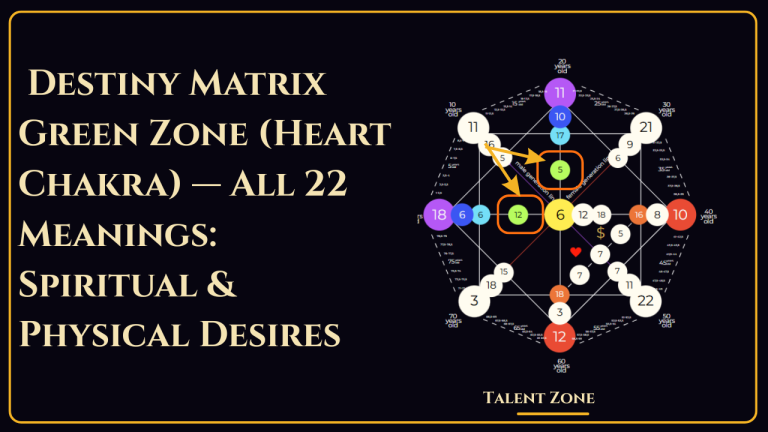
How to find your number: Generate your free Destiny Matrix chart Look at the karmic tail section at the bottom of the chart. Find the orange-coloured circle — the number inside it is your Relationship Channel position.
What the Relationship Channel Actually Means
The Relationship Channel sits at the entrance to the karmic tail — which is why it is sometimes called the Entrance to Relationships. This position can create specific patterns that repeat across different relationships:
The same dynamic tends to emerge regardless of who you are with. Relationships that start well develop the same friction. The same type of situation triggers the same emotional response. Partners who seem completely different from each other somehow create the same feeling in you.
This is not coincidence. It is the Relationship Channel operating at an unconscious level.
The good news is that once you can see the pattern clearly and specifically — which is what this number provides — it begins to lose its automatic power. Karmic patterns repeat because they are invisible. Naming them precisely is how you start working with them consciously rather than being run by them.
Important Note Before Reading
Each Arcana below has three parts: the pattern (what tends to repeat), the root (where it comes from energetically), and daily practice (what actively working with this looks like — not just awareness, but concrete action).
The pattern descriptions are not permanent character flaws. They are the unconscious default — what happens when this energy runs on autopilot. Working consciously with your Relationship Channel is what shifts the default into something that actually serves you.
All 22 Relationship Channel Arcana — Complete Meanings
Arcana 1 — The Magician
The Pattern: You find it genuinely difficult to show your real self in close relationships. You are capable, charming, and effective in the world — but intimacy requires a different kind of showing up, and that specific kind of vulnerability tends to get replaced with performance. Relationships stay engaging on the surface but rarely develop the depth that would actually satisfy you. Partners sense they are not quite getting the real you, even if they cannot name it. You may use humour, capability, or constant forward movement to avoid the moments when you would need to simply be present without an agenda.
The Root: In a past life, authentic self-expression may have led to manipulation or being used. The soul learned that showing your real capabilities creates vulnerability, and that concealment is safer than full disclosure. This karmic residue shows up as a habit of managing relationships rather than genuinely inhabiting them.
What This Looks Like in Relationships: Your partner may feel they are with someone impressive but not quite reachable. Conversations stay interesting but not truly intimate. You tend to redirect toward activity, planning, or problem-solving when emotional presence is what is actually needed.
Arcana 2 — The High Priestess
The Pattern: You have deep intuitive understanding — you often sense exactly what is happening in a relationship beneath the surface — but you consistently distrust that knowing and override it with logic or with what seems socially acceptable. This creates a recurring experience of being right about something important and dismissing it, then watching it play out exactly as you sensed. You may also struggle to understand what your partner is truly feeling, partly because you have disconnected from your own intuitive faculty, and partly because you use emotional distance as a way of managing the vulnerability that close relationships require.
The Root: In a past life, trusting intuition may have led to a significant betrayal — following an inner knowing into a situation that went badly wrong. The soul learned to distrust its own perception. This karmic pattern shows up as a habit of second-guessing what you clearly sense, and as a reflexive emotional withdrawal when intimacy deepens.
What This Looks Like in Relationships: You may say “I knew something was off” after a relationship difficulty — but during it, you explained away what you sensed. Emotional conversations feel draining rather than nourishing. You may prefer the early stages of relationships, when everything is still abstract, over the settled intimacy that requires full presence.
Arcana 3 — The Empress
The Pattern: You look to relationships to provide a sense of worth and value that you struggle to generate internally. This creates an imbalance where you either give too much — trying to earn love through provision and care — or feel that what you give is never properly recognised or returned. There is often a secondary pattern involving women: friction with a mother-in-law, female friends, or women in your partner’s life. This friction is usually a reflection of an unresolved relationship with the feminine principle — with nurturing, with abundance, with receiving.
The Root: In a past life, worth was conditional — dependent on what was produced, given, or achieved. Unconditional value was either absent or taken away. This karmic pattern creates a deep hunger to be loved simply for existing rather than for what you provide, alongside a habitual pattern of giving in order to earn that love.
What This Looks Like in Relationships: You may find yourself doing more and more in a relationship while quietly resenting that it is never enough. Or you may receive love with difficulty, deflecting compliments or finding reasons why your partner’s care is not quite genuine. With women in your partner’s life, small interactions can carry a disproportionate emotional charge.
Arcana 4 — The Emperor
The Pattern: You find it very difficult to genuinely trust another person with something you care about. In relationships, this translates into a persistent need to control outcomes — how decisions are made, how problems are handled, what the structure of the relationship looks like. You may not experience this as control; it often feels like simply being responsible, or knowing what works. But your partner experiences it as not being trusted, not being given space, or not being treated as an equal. Over time, this creates distance — either they pull away to find breathing room, or they become progressively less capable as you manage more.
The Root: In a past life, trusting others led to a significant loss — something important was damaged or taken away because someone else was responsible for it. The soul learned that the only reliable protection is personal control. This karmic pattern shows up as a genuine inability to let something you care about rest in someone else’s hands.
What This Looks Like in Relationships: You may give your partner clear responsibilities and then redo the outcomes or add detailed correction. Major relationship decisions tend to flow through you even when they nominally involve both of you. Your partner may feel safe in the relationship but somehow not equal in it.
Arcana 5 — The Hierophant
The Pattern: You have deeply held beliefs about what a relationship should look like — how roles should function, what commitment means, how conflict should be handled, what loyalty requires. These beliefs provide a strong sense of direction but also create rigidity: when your partner operates differently from your framework, it registers as a problem to be corrected rather than a different perspective to be understood. This can make relationships feel like they are always slightly failing to meet a standard, and your partner may feel judged or constrained by rules they never agreed to.
The Root: In a past life, established structures — religious, social, or familial — provided the only reliable framework for living. Deviation from those structures led to consequences. The soul learned to find safety in defined systems and to treat departure from them as dangerous. This karmic pattern shows up as an unconscious rigidity about how things should be done.
What This Looks Like in Relationships: Your partner may feel they are always being held to a standard they cannot quite locate. Disagreements can have a moral quality — as if the issue is not just a difference of preference but a failure of character. New ways of doing things get resisted even when the old ways are clearly not working.
Arcana 6 — The Lovers
The Pattern: You look to your partner to complete a sense of self that feels incomplete without them. This creates dependency — not necessarily in the practical sense, but emotionally: your mood, your sense of worth, and your experience of life tend to rise and fall with the state of the relationship. When things are good between you and your partner, everything feels possible. When there is friction, it can feel disproportionately destabilising. This pattern also creates a fear of genuine choice — because choosing one thing fully means closing off other possibilities, and that specific kind of commitment can trigger anxiety.
The Root: In a past life, love may have been conditional, withdrawn, or lost in a way that created a wound around being fully seen and fully chosen. The soul learned to seek from another what it could not generate internally: a sense of being enough, of being real, of mattering. This karmic pattern shows up as an unconscious search for completion in relationship.
What This Looks Like in Relationships: Your emotional state closely tracks the relationship’s state. Conflict feels more threatening than the situation warrants. You may find it difficult to be fully in one relationship because part of you is always aware of what being in this relationship means closing off. Your partner may feel simultaneously important and somehow insufficient — because no external relationship can actually fill an internal gap.
Arcana 7 — The Chariot
The Pattern: You bring significant energy, ambition, and forward drive into relationships — which is genuinely exciting at the beginning, but over time creates a pattern of conflict and competition. You may find yourself in ongoing power struggles with your partner — about decisions, about whose approach is right, about who leads and who follows. The relationship can start to feel like a competition rather than a partnership, with both of you focused on not losing ground rather than on building something together.
The Root: In a past life, survival and achievement were directly linked — only those who moved fastest, competed hardest, or won most consistently were safe. The soul learned to apply competitive energy to everything, including relationships. This karmic pattern shows up as a reflexive need to be in charge of the direction things move in.
What This Looks Like in Relationships: Disagreements tend to escalate beyond their actual content — it stops being about the specific issue and starts being about who is right. Your partner may feel they are constantly navigating your drive rather than benefiting from it. Moments of genuine shared vulnerability can be replaced by a focus on what needs to be achieved next.
Arcana 8 — Justice
The Pattern: You have a deeply felt sense of what is fair — and when relationships feel unequal, unreciprocated, or unjust, you find it very difficult to let it pass. This can create a persistent audit of the relationship: who has done more, who has given less, who owes whom what. Over time, this tracking creates distance — either because your partner feels constantly evaluated, or because you are carrying a running ledger of grievances that prevents genuine presence.
The Root: In a past life, injustice caused significant personal loss — perhaps being treated unfairly in a way that had lasting consequences. The soul learned to be perpetually vigilant about imbalance in order to prevent that experience from recurring. This karmic pattern shows up as a reflexive monitoring of relationship equity.
What This Looks Like in Relationships: Minor imbalances can register as significant violations. You may find yourself returning to old grievances that were supposedly resolved. Your partner may feel they are in a relationship with a judge rather than an equal. Generosity — the kind that gives without tracking return — is genuinely difficult.
Arcana 9 — The Hermit
The Pattern: You genuinely need significant solitude and inner space to feel like yourself — and in relationships, this need can be mismanaged in ways that create emotional distance without genuine depth. You may withdraw without explanation, processing everything internally while your partner is left in the dark. Or you may seek the idea of deep connection while finding the actual daily reality of a close relationship overwhelming. The result is a recurring experience of feeling alone in relationships, or of making partners feel alone in them.
The Root: In a past life, inner wisdom and solitude were the primary means of safety and understanding. Deep outer engagement — particularly with other people’s emotional worlds — may have been experienced as intrusive or depleting. The soul learned to retreat inward as its primary response to difficulty. This karmic pattern shows up as a reflexive withdrawal from connection when connection is what is actually needed.
What This Looks Like in Relationships: Your partner may feel they never quite know where they stand. Emotional conversations get processed internally rather than shared. You may seem present while being internally far away. The relationship can feel genuinely deep at the beginning, when it is still largely conceptual, and then flatten as real daily intimacy is required.
Arcana 10 — The Wheel of Fortune
The Pattern: You resist the natural changes and cycles that every real relationship moves through — wanting to hold onto what worked at the beginning when the relationship has moved into a different phase, or avoiding necessary endings because they feel like failures. You may also have a pattern of letting past relationship wounds carry forward into present relationships, unconsciously recreating familiar dynamics even when you are genuinely trying to do something different.
The Root: In a past life, significant change — likely experienced as sudden and destructive — created a deep association between change and loss. The soul learned to resist change in order to prevent that experience of loss from recurring. This karmic pattern shows up as a tendency to fight the natural cycles of relationship rather than move with them.
What This Looks Like in Relationships: Transitions in the relationship — moving in together, having children, a partner’s career change, the natural shift from new love to settled partnership — can be experienced as crises rather than natural progressions. Old relationship wounds surface in new relationships in surprisingly specific ways. Forgiving a past mistake is genuinely difficult, not because you do not want to but because the body has learned that dropping vigilance is dangerous.
Arcana 11 — Strength
The Pattern: You show remarkable patience with your partner’s difficulties, struggles, and imperfections — but express very little patience with your own. This creates a dynamic where you are consistently the stable, capable, understanding one, carrying more of the emotional weight than is sustainable, while quietly struggling beneath the surface. The impatience with yourself also leaks into the relationship in more subtle ways: you may become unexpectedly reactive when your own limits are reached, in ways that seem disproportionate because the pressure has been building invisibly.
The Root: In a past life, strength and endurance were survival requirements. Showing weakness or need was dangerous — either literally or in terms of social standing. The soul learned that others can be supported in their weakness but one’s own weakness must be concealed and managed. This karmic pattern shows up as a double standard between what is acceptable in others and what is acceptable in yourself.
What This Looks Like in Relationships: Your partner may feel they always receive your support but you never quite receive theirs — not because you reject it, but because you manage your own difficulties before they are visible enough to be supported. When you finally reach your limit, the reaction can feel disproportionate to your partner because they did not see the pressure that had been accumulating.
Arcana 12 — The Hanged Man
The Pattern: You tend to see situations in your relationship from your own perspective with clarity, but struggle to genuinely inhabit your partner’s viewpoint — particularly when you feel stuck or wronged. This creates a pattern of feeling trapped in relational situations that seem to have no good options, and a tendency to adopt a martyr position — suffering through rather than acting to change. There may also be a pattern of waiting for circumstances to change rather than making the choices that would actually shift things.
The Root: In a past life, situations that required action may have led to significant personal sacrifice — acting meant losing something important. The soul learned that staying still is safer than moving, and that suffering through is more reliable than choosing. This karmic pattern shows up as a habit of inaction and of seeing situations as fixed when they are actually changeable.
What This Looks Like in Relationships: Persistent friction may continue long past the point where addressing it would be possible, because the addressing feels more threatening than the friction itself. Your partner may feel they are waiting for you to make decisions or to speak clearly about what you need. Genuine compromise feels like loss rather than solution.
Arcana 13 — Transformation
The Pattern: You carry emotional weight from past relationships — wounds, betrayals, disappointments — that you have not fully released, and they filter your experience of current relationships in ways you may not fully recognise. When something in your current relationship triggers a familiar feeling from the past, the emotional response can be disproportionate to the current situation because it is carrying the past situation’s weight as well. There may also be a resistance to the endings and completions that healthy relationships naturally require — the end of a phase, the resolution of a conflict, the letting go of how things used to be.
The Root: In a past life, significant loss — particularly involving close relationships — created a wound that was never fully processed. The soul learned to hold on as a form of protection against loss recurring. This karmic pattern shows up as an inability to fully release what is over, and as emotional responses to the present that are weighted by the past.
What This Looks Like in Relationships: Your partner may sometimes feel they are dealing with reactions to events they were not part of. Certain specific topics or situations reliably trigger responses that seem larger than the current circumstance warrants. Conflict resolution can be difficult because something that seems resolved keeps resurfacing.
Arcana 14 — Temperance
The Pattern: You tend to oscillate between extremes in relationships rather than maintaining a sustainable middle ground. When things feel good, you may idealise the relationship and your partner. When things feel difficult, the difficulties can feel catastrophic. This can create an exhausting rhythm — both for you and for your partner — where the relationship swings between highs and lows rather than developing the kind of steady, grounded intimacy that sustains over time.
The Root: In a past life, moderation may not have been available — circumstances required all-or-nothing responses, and the middle ground was not safe or accessible. The soul learned to operate in extremes because that is what the situation demanded. This karmic pattern shows up as a difficulty accessing the middle register of experience.
What This Looks Like in Relationships: Your partner may feel the relationship’s emotional weather changes more quickly and more dramatically than the situations warrant. The very good periods and the very difficult periods can be so different that they feel like two different relationships. Steady, quiet, ordinary time together can feel anticlimactic rather than nourishing.
Arcana 15 — The Devil
The Pattern: Dependency, compulsion, or toxic relational dynamics tend to surface in your closest relationships — either your own or your partner’s, or both. This might look like emotional dependency, jealousy that goes beyond the situation warranting it, attempts to control through guilt or obligation, or a pattern of staying in situations that are clearly not serving either person because the attachment feels more powerful than the harm. The intensity can be genuinely compelling — relationships with this channel often have a magnetic quality — but that same intensity can tip into something that controls rather than connects.
The Root: In a past life, powerful attachment — to a person, a place, a status, or a way of life — may have been the primary source of meaning and security. When that attachment was threatened or lost, it was catastrophic. The soul learned that the strength of attachment is the measure of its importance, and that intensity equals love. This karmic pattern shows up as a tendency to confuse attachment with genuine connection.
What This Looks Like in Relationships: The early stages of relationships may feel overwhelmingly compelling. Jealousy or fear of loss can surface in situations that do not objectively warrant them. It may be difficult to leave a relationship that is clearly not working because the pull of the attachment is stronger than the evidence of the harm. Your partner may sometimes feel controlled or obligated rather than genuinely loved.
Arcana 16 — The Tower
The Pattern: Sudden changes and crises in relationships — discoveries, upheavals, unexpected endings — tend to hit you harder than the situation alone warrants, because they activate an older fear of sudden loss or destruction. You may manage this by attempting to prevent change and disruption through control, vigilance, or by staying in relationships that are not working because at least they are stable. When disruption comes anyway — as it always does — the response can be reactive, dramatic, or disproportionate.
The Root: In a past life, a sudden and unexpected collapse — of a relationship, a family structure, a way of life — created a deep association between change and catastrophe. The soul learned to be perpetually alert to signs of impending collapse, and to respond to instability with maximum intensity. This karmic pattern shows up as a crisis response that activates more quickly and more intensely than situations typically warrant.
What This Looks Like in Relationships: Minor conflicts can trigger a fear of the relationship ending. Change — even positive change — can feel threatening. Your partner may feel they need to manage the delivery of difficult information carefully because of how strongly you respond. Genuine stability, once established, may feel almost suspicious — as if the calm is just the pause before the next crisis.
Arcana 17 — The Star
The Pattern: You have a tendency to idealise relationships and partners, which means the inevitable arrival of reality can feel like a loss or a failure rather than the natural deepening that all genuine relationships require. When a partner does not live up to the ideal you had constructed, or when the relationship does not feel as it did at the beginning, you may become discouraged or start looking for what was lost. This can create a pattern of multiple relationships that each start with great hope and then disappoint — not because the partners are wrong but because the gap between the ideal and the real keeps triggering withdrawal.
The Root: In a past life, hope was one of the few sustainable resources — the idea of how things could be was more reliable than how they actually were. The soul developed a powerful relationship with possibility and potential, and learned to orient toward the ideal as a survival mechanism. This karmic pattern shows up as a preference for the possible over the actual.
What This Looks Like in Relationships: The beginning of relationships feels genuinely wonderful — the person seems to perfectly match what you have been looking for. As the reality of who they are fully arrives, there can be a sense of disappointment that is actually the disappointment of the ideal not matching the person. Your partner may feel they are always falling slightly short of something they cannot quite locate.
Arcana 18 — The Moon
The Pattern: Insecurity, jealousy, and an inability to accurately read your partner’s intentions tend to create significant difficulty in your closest relationships. You may find yourself uncertain about your partner’s feelings even when there is no concrete reason for doubt. Or you may sense something is off and be unable to distinguish between genuine intuition and anxiety-generated suspicion. This uncertainty tends to create the very distance it fears — the more you reach for reassurance, the more pressure your partner feels, and the more they pull back, which confirms the original fear.
The Root: In a past life, emotional reality was genuinely unclear — perhaps deception was involved, or the emotional environment was genuinely inconsistent in ways that made reliable trust impossible. The soul learned to be hypervigilant about emotional signals and to treat ambiguity as danger. This karmic pattern shows up as an inability to rest in the security of a relationship even when that security is real.
What This Looks Like in Relationships: You may seek reassurance frequently, or conversely suppress the need for reassurance entirely and then experience an unexpected collapse of trust. You may test your partner’s commitment in indirect ways. Certain situations — your partner spending time with others, changes in their communication pattern, moments of distance that are actually just normal variation — can trigger disproportionate fear.
Arcana 19 — The Sun
The Pattern: You link your happiness in relationships to external validation and visible success — the relationship needs to feel good in the eyes of others, to be performing well, to generate a visible warmth and positivity. When the private reality of the relationship is difficult, this can create a gap between how things look and how they feel — which is genuinely exhausting to maintain. There may also be a tendency to seek attention and brightness outside the relationship when the inside feels flat, which can create real tension.
The Root: In a past life, being bright, successful, and celebrated was the primary source of safety and belonging. Dimness, difficulty, or failure carried real social cost. The soul learned that positivity and performance are what make you acceptable and valued. This karmic pattern shows up as a need for relationships to generate and display a particular kind of warmth and happiness.
What This Looks Like in Relationships: The public version of the relationship may look consistently better than the private version feels. Difficult conversations can be avoided because they interrupt the warmth. Your partner may feel they cannot bring genuine difficulty to you without it being resolved too quickly into positivity. You may find that you are charming and warm in social situations but harder to reach in private ones.
Arcana 20 — Judgement
The Pattern: You find it genuinely difficult to move past significant mistakes — either your own or your partner’s — and this creates a persistent weight in your relationships. Old wounds get revisited. Past mistakes become evidence of character rather than events to learn from and release. You may also carry unresolved family of origin patterns into your relationships in specific ways — dynamics from your parents’ relationship or from your relationship with your parents tend to surface with unusual precision in your own partnerships.
The Root: In a past life, moral reckoning — judgment in the theological or karmic sense — shaped the soul’s experience significantly. Either you were judged harshly and could not defend yourself, or you judged others harshly and carried that weight. The soul learned that mistakes have lasting consequences, and that full release requires some form of reckoning that rarely seems to arrive. This karmic pattern shows up as a difficulty closing chapters.
What This Looks Like in Relationships: Forgiveness is offered but not fully granted — the matter tends to resurface. Your partner may feel that certain events are never truly resolved. Family patterns — how conflict was managed in your family of origin, the relational dynamic between your parents — may appear in your own relationship with surprising accuracy. Hearing criticism from a partner can feel disproportionately significant because it activates a deeper layer of judgment.
Arcana 21 — The World
The Pattern: You struggle to feel fully present and genuinely whole in your closest relationships — as if there is always something missing, or as if the relationship is one chapter in a larger story that has not yet fully arrived. This can show up as a persistent sense of incompleteness even in relationships that are objectively good, or as a difficulty fully committing because something in you is still waiting for the right moment, the right circumstances, the full version of what this could be.
The Root: In a past life, genuine completion — the satisfaction of something fully achieved, fully lived, fully integrated — may have been interrupted before it arrived. The soul learned to live in a state of ongoing becoming rather than being, always moving toward completion rather than inhabiting it. This karmic pattern shows up as a difficulty resting in the fullness of what is actually present.
What This Looks Like in Relationships: Even very good relationships can carry a background feeling of “not quite yet.” Your partner may sense that they are not quite enough — not because anything specific is wrong, but because you seem to be waiting for something else. Commitment can feel like an ending rather than a beginning. Periods of genuine contentment can feel suspicious — as if things being good means something is about to change.
Arcana 22 — The Fool
The Pattern: You bring a genuine quality of openness and freshness to relationships — new experiences, spontaneity, genuine delight in the unexpected — but this same quality can tip into carelessness about consequences, an avoidance of the sustained commitment and ordinary reliability that real relationships require, and a tendency to start things without seeing them through. Your partner may feel they are always slightly uncertain about whether you will stay — not because you are unreliable as a person, but because you seem to treat commitment as something that might change if something unexpected arrives.
The Root: In a past life, fixed commitment — to a person, a place, a path — may have ended in loss or constraint. The soul learned to treat lightness and freedom as survival resources, and to treat commitment as something that makes loss more painful rather than something that creates genuine safety. This karmic pattern shows up as a reflexive orientation toward openness over commitment.
What This Looks Like in Relationships: The beginning of relationships tends to be genuinely wonderful — your openness and enthusiasm are magnetic. As the relationship settles into ordinary life, the frequency of new experiences can drop off and something starts to feel flat. Your partner may need more explicit reassurance of your commitment than you naturally provide. Serious conversations about the future can feel constraining rather than exciting.
How to Work With Your Relationship Channel
Understanding your Relationship Channel is the beginning, not the end. Here is how to actually apply it:
Step 1 — Recognise the pattern without judgment. The pattern described in your arcana is not a character defect. It is an unconscious default that developed for a reason. Recognising it with curiosity rather than self-criticism is what allows it to be worked with.
Step 2 — Show your partner. Sharing your Relationship Channel with your partner creates a specific kind of understanding that is genuinely useful. When a familiar pattern activates, being able to say “I think my Relationship Channel is running right now” gives both of you a name for what is happening that is not accusation.
Step 3 — Apply the daily practice consistently. The practices above are specific for a reason. The Relationship Channel does not change through insight alone — it changes through repeated, small, conscious actions that gradually create a new default.
Step 4 — Read it alongside your Karmic Tail. Your Relationship Channel is one position within your broader Karmic Tail. Understanding both together gives you the complete picture of what your soul carried into this lifetime around relationships and what it came here to work through.
Step 5 — Check your partner’s Relationship Channel. Understanding both your own and your partner’s Relationship Channel is one of the most practically useful things a couple can do with the Destiny Matrix system — because it shows you both exactly where each person’s karmic work in relationships lives.
Find Your Relationship Channel
Generate your free Destiny Matrix chart — your date of birth is all you need.
All Destiny Matrix interpretations are based on the original Natalia Ladini method (2006). For informational and self-reflection purposes only. See our Disclaimer for full details.