Destiny Matrix vs Human Design — Which One Actually Tells You Something Useful?

If you have spent any time in the self-discovery space, you have probably tried at least one of these. Maybe both. Human Design has been around since the late 1980s and built a genuinely devoted following. The Destiny Matrix arrived in 2006, created by Russian numerologist Natalia Ladini, and has been growing quietly ever since — particularly among people who tried Human Design first and found themselves wanting something more specific.
This is not an article that declares one system better than the other in the abstract. Both have genuine value. But they work very differently, they ask for different information, and they tend to produce different kinds of insight — which means they are more or less useful depending on what you are actually trying to understand about yourself.
If you have tried one and are curious about the other, this guide breaks down exactly what each system covers, where each one tends to hit well, and where each one falls short. No filler. No vague “both systems are beautiful” conclusions. Just a genuinely useful comparison.
The Most Important Difference Before Anything
Before comparing what each system reveals, there is one practical difference that determines whether you can even use them:
Human Design requires your exact birth time and birth location.
Not approximately. Not roughly. The Human Design chart changes meaningfully if your recorded birth time is off by even 15 minutes. If you do not have your birth certificate — or if the birth time recorded on it is uncertain — you cannot generate a reliable Human Design chart. This eliminates a larger portion of people than you might expect. Many people genuinely do not know their exact birth time. Others have a time on record that they suspect is approximate.
The Destiny Matrix requires only your date of birth.
Day, month, year. That is it. No birth time. No birth location. The calculation is entirely date-based. Two people born on the same date will produce the same numbers — and the specificity comes from the combination of positions in the chart, not from astronomical precision.
This is not a minor point. It is the reason many people arrive at the Destiny Matrix after trying Human Design — not because Human Design disappointed them, but because they could not generate a reliable chart in the first place.
If you have your exact birth time and location confirmed, Human Design is fully available to you and worth exploring seriously. If you do not — or if you have doubts about the time on record — the Destiny Matrix is the more reliable starting point.
What Each System Actually Is
Human Design
Human Design was developed by Ra Uru Hu (born Alan Robert Krakower) in 1987 following a reported mystical experience in Ibiza. It synthesises several existing systems — the I Ching, the Kabbalah’s Tree of Life, the Hindu-Brahmin Chakra system, and Western astrology — into a single framework that produces a “BodyGraph” based on your birth data.
The BodyGraph shows nine energy centres (similar to chakras), 64 gates (drawn from the 64 hexagrams of the I Ching), and 36 channels connecting those gates. Based on the configuration of these elements at the moment of your birth, Human Design assigns you a Type (Generator, Manifesting Generator, Projector, Manifestor, or Reflector), a Profile, an Authority (your decision-making strategy), and a Strategy (how you are designed to move through the world).
Human Design is a rich system with a large body of developed interpretation. Its practitioners have been working with it for nearly 40 years, and the depth of the framework reflects that. A full Human Design reading is a genuinely complex thing.
The Destiny Matrix
The Destiny Matrix was developed by Natalia Ladini in 2006. It draws on Numerology, the 22 Major Arcana of Tarot, Kabbalistic principles, and the Chakra energy system to generate an octagram — an eight-pointed star — from your date of birth.
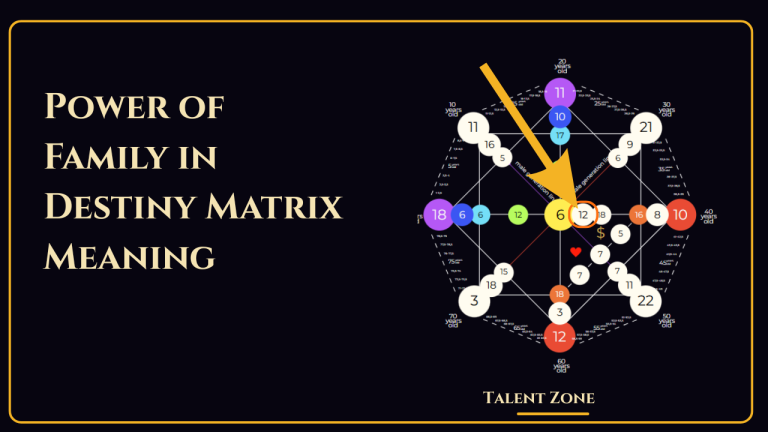
The octagram contains 22 active positions, organised into 10 distinct dimensions: your Core Essence, Karmic Tail (26 possible combinations), Relationship Channel, Money Line, Portrait Zone, Talent Zone, Heart Center, Power of Family, Paternal Line, Maternal Line, and Life Cycles from birth to age 75.
Each position shows both the positive expression of that energy and its shadow side — the unconscious pattern that tends to operate when the energy is unexamined.
Side by Side — What Each System Covers
| Human Design | Destiny Matrix | |
|---|---|---|
| Input required | Exact birth time + location | Date of birth only |
| Primary output | Type, Profile, Authority, Strategy | 22-position octagram |
| Core personality | Type + Profile | Core Essence (Central Arcana) |
| Decision-making | Authority (9 types) | Not covered directly |
| Recurring life patterns | Not a primary focus | Karmic Tail (26 combinations) |
| Relationship blueprint | Defined/undefined centres | Relationship Channel + Ideal Partner |
| Financial energy | Not specifically mapped | Money Line (22 arcana) |
| Natural gifts/talents | Specific gates and channels | Talent Zone (3 positions) |
| Life purpose | Profile + Incarnation Cross | Personal + Social + Planetary Purpose |
| Ancestral patterns | Not covered | Power of Family (22 combinations) |
| Life phases/timing | Not covered | Life Cycles (8 outer circles, birth-75) |
| Heart desires | Not covered | Green Zone / Heart Center |
| Shadow side shown | Conditioning and “not-self” theme | Shadow side for every position |
| Cost to access | Often paid readings | Free calculator |
Where Human Design Tends to Hit Well
Decision-making and strategy. Human Design’s Authority system is one of its most practically useful outputs. Knowing whether you are designed to make decisions from gut response, emotional clarity over time, splenic intuition, or something else entirely — and actually testing that in your life — genuinely changes how people relate to their choices. The Destiny Matrix does not have an equivalent to this.
Energy management. The defined and undefined centres in Human Design map how you are designed to generate, manage, and be affected by energy. For people who have spent years feeling exhausted in certain environments or consistently amplifying others’ emotions without understanding why, the Human Design centre system often provides genuinely useful context.
The “not-self” theme. Each Human Design Type has a characteristic emotional state that signals when you are operating out of alignment — frustration for Generators, bitterness for Projectors, anger for Manifestors, and so on. Many people find this specific signal genuinely useful as a real-time indicator.
Depth of community and resources. Human Design has been developed and refined over nearly 40 years. There is a large body of material, trained practitioners, and well-developed interpretation for edge cases. If you want to go very deep, there is a lot to go deeper into.
Where the Destiny Matrix Tends to Hit Well
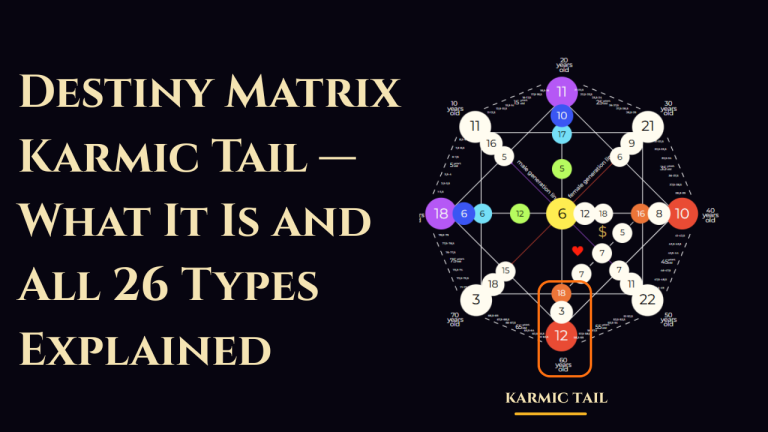
Recurring patterns. The Karmic Tail is the section of the Destiny Matrix that most people find most immediately accurate — and it has no real equivalent in Human Design. The specific three-number combination that forms your Karmic Tail describes the persistent pattern beneath your most recurring struggles: the same dynamic that keeps showing up in different relationships with different people, in different jobs with different circumstances, feeling identical underneath. Most people read their Karmic Tail and recognise it within the first paragraph.
Financial specificity. The Money Line in the Destiny Matrix is specific in a way most systems are not. It describes the professional environments where your energy produces results most naturally, the specific way abundance tends to move toward you based on your birth date, and the particular energetic block most commonly creating a financial ceiling for people with your configuration. Human Design touches on this through undefined centres and gate activations, but the specificity of the Money Line often lands more immediately.
Ancestral and family patterns. The Power of Family, Paternal Line, and Maternal Line positions in the Destiny Matrix map inherited patterns in ways Human Design does not address. For people trying to understand why certain family dynamics keep repeating across generations — or why they respond to their parents in specific ways they have not been able to explain — these positions often provide the clearest answer they have found.
Accessibility without birth time. The practical reality: if you do not have a confirmed birth time, the Destiny Matrix gives you a complete, reliable reading. Human Design, without a confirmed birth time, gives you a chart you cannot fully trust.
Both shadow and light together. Every position in the Destiny Matrix shows both the positive expression and the shadow side. Human Design describes conditioning and not-self themes, but the Destiny Matrix makes the shadow side explicit for every position — which many people find more immediately useful for understanding their own patterns.
The “I Tried Human Design and Something Was Off” Situation
If you have tried Human Design and found it resonating in some places but not others, there are a few common reasons:
Birth time uncertainty. If your chart was generated with an approximate time, certain elements — particularly your Profile and some centres — may be inaccurate. A 15-minute difference can change the Profile entirely. If this is a concern, it is worth treating those specific outputs with some scepticism while keeping what clearly resonates.
The system requires significant study. A basic Human Design reading gives you your Type and a few key principles. A genuinely useful reading requires considerable study of the gate and channel system. Many people find that the initial “you are a Projector/Generator” insight is clear, but deeper specificity requires significant investment in learning the system. The Destiny Matrix tends to produce usable specificity faster.
Some elements simply do not land. Human Design, like any system, does not produce equally resonant outputs for every person. If your Authority does not match your experience of how you actually make good decisions, that is worth noting — rather than assuming the system is always right and your experience is always wrong.
The “I Tried Destiny Matrix and Want to Go Deeper” Situation
If you have generated your Destiny Matrix chart and want to go further, a few directions worth exploring:
The Karmic Tail in depth. The three-number combination is the starting point. Understanding how the three arcana interact with each other — not just reading each number separately — tends to produce the most specific insight. This is worth sitting with rather than moving quickly through.
Life Cycles in context. The eight outer circles of your chart map the energetic themes of each life phase. Placing your current age range in context — what the current cycle is about energetically, and what the next phase is moving toward — gives the chart a temporal dimension that many people find immediately useful.
Reading shadow and positive together. The instinct is usually to read the positive expression of each position and stop there. The shadow side is typically where the most immediately applicable insight lives — because it names what has been operating unconsciously, which is where the real patterns are.
Can You Use Both?
Yes — and many people do. They are not competing systems. They address different questions, use different inputs, and produce different kinds of insight. If you have your confirmed birth time and location, trying Human Design alongside your Destiny Matrix chart gives you a more complete picture than either alone.
A few people find that one resonates clearly and the other does not — and that is fine too. Self-discovery systems are tools, not doctrines. What matters is whether a particular framework gives you something genuinely useful for understanding your own patterns and making better decisions. If it does, it is worth your time. If it does not, it is not a moral failure — it just may not be the right tool for how your mind works.
The best starting point is usually the one you can actually access reliably. If you do not have a confirmed birth time, start with the Destiny Matrix. If you do have it, explore both — and pay attention to which sections of each system produce the most immediate recognition.
Quick Summary
Choose Human Design first if:
- You have your confirmed exact birth time and location
- You want specific guidance on decision-making strategy
- You are interested in energy management and centre dynamics
- You have time to invest in learning a complex system deeply
Choose the Destiny Matrix first if:
- You do not have a confirmed exact birth time
- You want to understand recurring life patterns quickly
- Financial specificity (Money Line) is a priority
- You want to understand ancestral and family patterns
- You want both shadow and positive sides made explicit
- You want something free and immediately accessible
Both are worth trying if:
- You have all the required information for Human Design
- You are willing to sit with what resonates and set aside what does not
- You understand both as tools for self-reflection, not scientific predictions
Frequently Asked Questions
Which is more accurate — Human Design or the Destiny Matrix?
Neither is “accurate” in a scientific sense — both are self-reflection frameworks built on symbolic systems. What differs is specificity and what each system addresses. Most people find the Destiny Matrix Karmic Tail and Money Line produce more immediately specific recognition than comparable Human Design outputs. But Human Design’s Authority and Strategy are often more immediately applicable for decision-making than anything in the Destiny Matrix. Accuracy depends on what you are measuring.
Can I use the Destiny Matrix if I do not know my birth time?
Yes — the Destiny Matrix requires only your date of birth. No birth time or location is needed. This is one of its primary practical advantages over Human Design and astrology.