The Destiny Matrix Positions Everyone Skips — And Why They Matter More

There is a predictable pattern to how people read a Destiny Matrix chart for the first time.
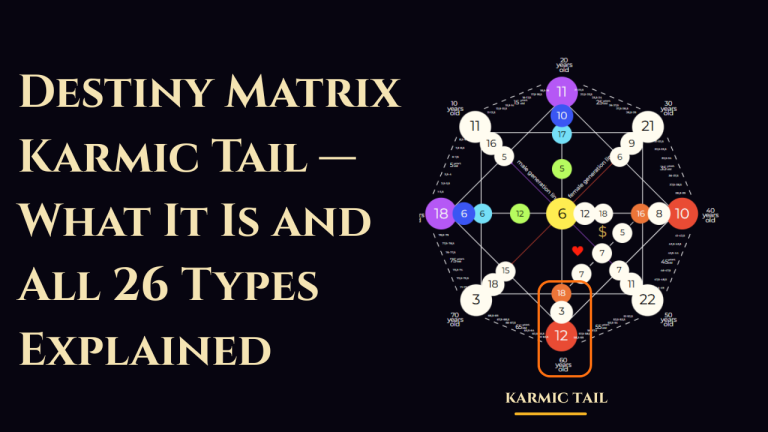
They go straight to the Karmic Tail. Then the Love Line. Then the Money Line. Then, if there is energy left, the Central Arcana. Four positions out of twenty-two, and the reading is done.
This is not a criticism — those four are genuinely the most dramatic. They promise to explain your recurring struggles, your relationship history and your financial ceiling. Naturally people start there.
But here is what happens next, consistently. People read those four, get something out of them, and then find themselves stuck. The pattern has a name now and it has not moved. The reading was accurate and nothing changed.
The positions that tend to unlock that stuck point are almost always the ones that got skipped. Not because they are secret or advanced, but for a much more ordinary reason: they do not promise anything dramatic, so nobody reads them.
This guide covers six of those positions, why each one gets overlooked, and what it actually tells you.
Why some positions get skipped
Worth understanding the mechanism before the positions themselves, because it explains why this happens to almost everyone.
The four popular positions all share one quality: they name a problem. Recurring struggles. Relationship patterns. Money blocks. Core identity. Each one offers a diagnosis, and a diagnosis is satisfying to read.
The skipped positions do not name problems. They describe conditions — the background settings your life runs on. Nothing about them is urgent, which is precisely why they get passed over.
And that is the mistake. A diagnosis tells you what is wrong. Conditions tell you why the wrong thing keeps being possible. You need both, and most people only ever read the first.
1. The Sky Line and Earth Line
Why it gets skipped: The names sound abstract. Nothing about “Sky Line” suggests it will explain anything about your Tuesday.
What it actually is: Two axes running through your chart. The vertical axis — Sky Line — is read as your spiritual and mental orientation: how you make meaning, what you believe about how life works, what you assume is true before you have examined it. The horizontal axis — Earth Line — is read as your material and physical orientation: how you handle practical reality, resources, the body, the actual mechanics of getting through a week.
Why it matters more than it looks: Almost every persistent life friction is a Sky-Earth mismatch.
The person whose Sky Line describes expansion and whose Earth Line describes caution will start things constantly and never build them. The person whose Earth Line is strong and Sky Line is quiet will build efficiently toward things that stop mattering halfway through. Neither problem shows up in the Karmic Tail. Both show up here.
What to actually look for: Compare the two numbers. If they share a character — both structural, both expansive, both cautious — your inner and outer life are pulling the same direction, and that is a real advantage. If they conflict, you have found the source of a friction you have probably been attributing to willpower.
2. Material Karma
Why it gets skipped: People read the Money Line and assume they have covered money. Material Karma sits along the same line and looks like a footnote.
What it actually is: The specific position read as the interference pattern in your financial life. Not how you earn — the Money Line covers that — but what reliably gets in the way.
Why it matters more than it looks: The Money Line tells you the shape of earning that suits you. Material Karma tells you why you keep not doing it.
This is the gap most people never close. They read the Money Line, recognise it, agree with it — and continue doing something else entirely. Material Karma describes the mechanism behind that gap. Usually it is not laziness or bad luck. It is a specific inherited assumption about money that has never been stated out loud, and therefore never examined.
What to actually look for: Read this position and ask a different question than usual. Not “is this true about me” but “where did I learn this.” Material Karma readings tend to trace back to a household attitude rather than a personal decision. The money blocks guide covers the individual patterns.
3. Social Purpose
Why it gets skipped: Purpose positions get collapsed into one thing. People read “purpose,” find one number, and move on — without realising there are several, describing different scopes.
What it actually is: Your chart contains a personal purpose (read as most active before roughly forty), a social purpose (your contribution within your immediate world — family, work, community), and beyond that the Planetary Purpose at the widest scale.
Social Purpose sits in the middle and is the one most people never locate.
Why it matters more than it looks: It is the only purpose position that describes something you can act on this month.
Personal purpose is about your own development, which is slow and internal. Planetary Purpose describes a lifetime arc that often does not activate until later. Social Purpose describes what you are meant to contribute in the rooms you are already in — your team, your family, your community. It is immediately actionable in a way the other two are not.
What to actually look for: Read it against your current situation rather than as an abstraction. The question is not “what is my social purpose” but “is there a version of this I could be doing where I already am?” The answer is usually yes, and usually smaller than expected.
4. The Paternal and Maternal Lines
Why they get skipped: People assume these describe their parents, decide the descriptions do not match, and stop reading.
What they actually are: The energetic inheritance from each side of the family — the paternal line from your father’s lineage, the maternal from your mother’s. Not the individuals. The line.
Why they matter more than they look: This is the most common misreading in the entire chart, and correcting it changes what the positions are worth.
The paternal line does not describe your father. It describes what came down that side of the family — which may have expressed strongly in your grandfather, skipped your father entirely, and landed on you. A trait can appear in an uncle and nowhere else. A pattern can go dormant for a generation.
When people say “this doesn’t match my dad at all,” they are usually right about their dad and wrong about what the position claims.
What to actually look for: Ask about the line, not the person. What was true of the men in your father’s family generally? What did the women in your mother’s family have in common? Frequently the answer is something nobody ever discussed — an attitude to work, a way of handling conflict, a relationship with money that everyone had and nobody named.
The Power of Family position sits at the centre and blends both lines. These two positions separate them out, which is where the useful detail lives.
5. Child-Parent Balance
Why it gets skipped: The name sounds like it is only for parents. Most people without children skip it entirely.
What it actually is: Two related positions. One describes the dynamic between you and your parents — what was given, what was missing, how it shaped you. The other describes how you relate to your own children, if you have them.
The first one applies to everyone. Everyone had parents.
Why it matters more than it looks: This position frequently explains something the Karmic Tail describes but does not source.
The Karmic Tail names a pattern. Child-Parent Balance often names where it was installed. Not in a blame sense — most of these dynamics were unintentional, and the parents were usually running their own inherited version. But knowing where a pattern entered changes what you can do about it. A pattern that feels like your personality is hard to work with. The same pattern, understood as something absorbed at seven years old, becomes considerably more workable.
What to actually look for: Read it as a description of a dynamic rather than an accusation. The useful question is what this position says you were not given, because that is usually what you have been trying to source from other relationships ever since.
6. The Life Force Position
Why it gets skipped: It is usually labelled in a way that makes people scroll past it quickly, and most guides say almost nothing about it.
What it actually is: Read as your core creative and vital energy — the drive underneath everything, before it gets directed toward anything specific. It covers creative output, physical vitality, sexuality, and the general question of how much fuel is in the system.
Why it matters more than it looks: Because every other position in your chart depends on it.
You can have an excellent Talent Zone, an aligned Money Line and a clear purpose, and none of it moves if this position is depleted or blocked. This is the position that explains why someone with genuine ability and clear direction still cannot seem to start.
It also tends to be the position people are least honest with themselves about — partly because it touches on subjects that are uncomfortable to consider analytically, and partly because low vitality is easy to reinterpret as being busy.
What to actually look for: Read the shadow side of this position specifically. The strong expression is usually obvious to you. The strained expression describes how your energy leaks — and that is generally not obvious at all, because it has been happening long enough to seem normal.
Which one to read first
Depends on where you are actually stuck.
| If this is your situation | Read this position |
|---|---|
| You know the pattern and it has not moved | Child-Parent Balance |
| You start things and do not finish them | Sky Line vs Earth Line |
| The Money Line makes sense and nothing changed | Material Karma |
| You want purpose you can act on now | Social Purpose |
| Family dynamics you cannot explain | Paternal and Maternal Lines |
| Ability and direction are clear, motion is absent | Life Force |
Why the skipped positions tend to be more reliable
Something worth stating plainly, because it goes against how this material is usually presented.
The popular positions make large claims. The Karmic Tail claims to explain your recurring struggles. The Love Line claims to explain your relationship history. Large claims are compelling — and large claims are also where interpretation drifts furthest from the method, because dramatic content sells and cautious content does not.
The skipped positions make small claims. Sky Line describes an orientation. Material Karma describes an interference. Social Purpose describes a scope. None of them promise to explain your life.
That restraint is exactly why they hold up better. A position describing conditions is harder to over-interpret than a position promising a diagnosis, and it is considerably harder to sell a clearing session for.
The most useful readings tend to come from the least dramatic positions. That is true of this system and it is true of most systems, and it is the opposite of how the material is usually ordered
What this does not mean
It does not mean the popular positions are wrong. The Karmic Tail is genuinely the most immediately recognisable section for most people, and that is a real quality. This is about reading order and completeness, not about replacing one set with another.
It does not mean more positions equals better insight. Reading all twenty-two positions in one sitting produces less than reading six carefully. The point is not volume — it is that the six you skipped are probably the six that answer the question you are still holding.
It does not make the chart predictive. None of these positions forecast anything. They describe conditions and tendencies, which is a different category of claim.
Frequently asked
How do I find these positions on my chart? Generate your chart and click through the sections — each position is labelled. The Sky and Earth Lines are the vertical and horizontal axes through the centre. Material Karma sits on the money diagonal. The parental lines are the outer corner positions.
Should I read all twenty-two positions? Eventually, over several sittings. Not in one go. A chart read carefully in sections over a few weeks produces considerably more than one read exhaustively in an evening.
Which position is genuinely the most important? The Central Arcana, for context. But the most useful position varies by person and by what you are stuck on — which is the argument this entire guide is making.
My skipped positions do not resonate either. Now what? That is a legitimate outcome. This is a symbolic framework, not a measurement, and it does not land equally for everyone. A reading you have to argue yourself into is not insight — and noticing that is more valuable than forcing a fit.
Where should I read next? The Talent Zone guide if the Life Force section resonated, or the money blocks guide if Material Karma did.
The Destiny Matrix is a framework for self-reflection. It is not diagnostic or predictive, and nothing here is medical, financial or psychological advice.



One Comment